
Happy one year of blogging! If that’s what you can even call writing a blog post once every 3 months. A bit of a heavier one today. I’m sure by now everyone now is aware of the ongoing protests in the fight for justice for George Floyd and the many other black people that have been a victim of police brutality, not only in the US but worldwide. This is the third sentence in this blog post, and I must have written it ten times by now. Honestly I don’t really know what to say. I’m petrified of saying the wrong thing. As a white woman in the UK, although I can educate myself, I will never experience the issue. Because of this reason, I’m in no way eloquent or informed enough about this to write about it. I want to listen and learn but as of right now, there’s no way I could ever find the right words to say what I want to say. Instead I’m going to write about something I do know. Graphic Design.
Over the last three weeks, I’ve seen hundreds of protest signs on Instagram. Some, you can clearly tell have taken a while, have been well thought out and planned with pencil, while others have had to cram some letters too close to the end of their board because they were a bit too ambitious with their spacing. Protests like these, although maybe not quite as wide spread, aren’t new to society. There are so many important issues, just like this one that have been protested over the years. It got me thinking about the history of protest signs and wondering about what makes up the best qualities of a good protest art.
This blog post idea was sparked from watching 13th on Netflix (a small attempt to educate myself). Made by Ava DuVernay about race in the USA’s criminal justice system, the documentary is named after the 13th amendment that outlawed slavery unless used for crime punishment. Bringing light to the mass incarceration of people of colour, the documentary uses bold statistics to inform and educate whilst also displaying strong graphical elements to support. Putting two and two together, I immediately realised that these graphics mimicked those of protest art.

Made by Elastic, a collective we’re no stranger to after seeing their work for the season 8 title reel of Game of Thrones, they create some truly magical stuff but really do keep their processes well hidden. Brilliant for them, not so brilliant for me. The typeface used was a bitch to find. I ended up using a not so trustworthy site that find similar matches to the image of the font you’re trying to identify. TT Backwards Sans Bold looks the most similar along with Bebas Neue, both a narrow grotesque style similar to that used in book design in the 70s and 80s. The sans serif, bold style means it’s concise, direct and puts the message across very clearly, which is not only perfect for 13th but also protest art. The style of colouring is also similar to that of protest art, as they use what looks like a printed effect on the type making it look handmade. Although 13th was made before the recent riots, Black Lives Matter is not a new movement.

Founded in 2013, the movement began by the use of the hashtag on social media after the acquittal of George Zimmerman in the shooting death of Trayvon Martin in 2012. Being well known for their street demonstrations, direct action is arguably how BLM gains most attention. Using specific political slogans such as simply ‘Black Lives Matter’ to the most relevant in the recent protests ‘I can’t breathe’, BLM tends to use memorable wording from black victims of police brutality alongside classic word tricks like rhyming and personal hits such as ‘Is my son next?’. As painful as these slogans are, they’re the perfect example of how to get the message across. Short, punchy and meaningful. Touching that personal, raw emotion that’s in everyone can also impact just as much as a strong, empowering call to action.

Protests like these as previously mentioned weren’t started by BLM. Protests have been an important part of American history since well before the Civil Rights Movement in the 60s. Although there’s no direct date online, one of the first official dates of picketing I could find in the US was in 1917 when Alice Paul and the National Women’s Party picketed the White House. However, protest art overseas has evidence of creation in the early 1900s. Obviously the countries and areas that have most social injustices have the most protest art. Picketing can be done for many different reasons and in many different locations but usually the reason impacts the location. It’s shown that BLM protests are obviously more likely in states where black victims have lost their lives. There has been a massive boom in the creation of such art in the last thirty years worldwide with a change to a more accepting societal opinion.

Protest art is a very fluid and mouldable thing, as a lot of boards are often inspired by boards created from another movement and era. Well known names like Guerrilla Girls and Extinction Rebellion have found their mojo in the creation of protest art, finding that it’s something they were quite good at. What you find from looking at their creations is that although they appear to look very different, they have a lot of the same qualities. Clear messages, strong type, effective imagery, protesting in the right location at the right time. If what you’re protesting is presented in the right way to the right people, the message will be sent.
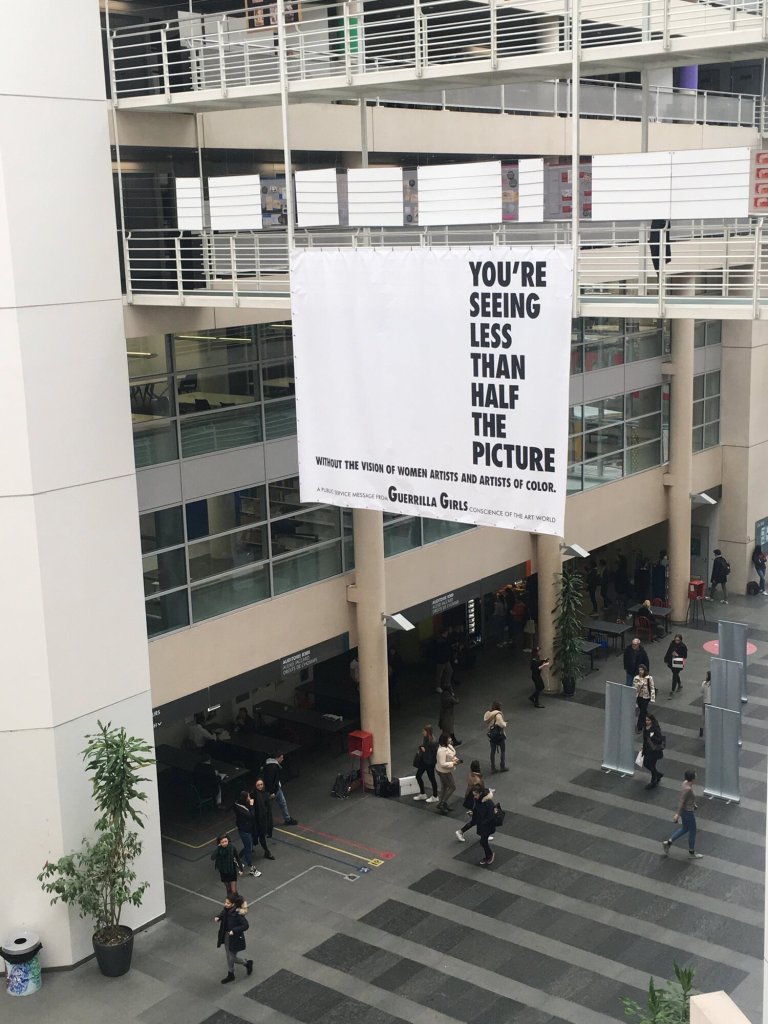
As always, links to works are on the related images. Anything said in this was not meant to offend anyone, I’m still learning so please correct me if I’ve made any mistakes or been insensitive in any way. If you’re making protest art anytime soon, don’t forget strong messages, clear type, and effective imagery. You want your message to be heard.
If you wish to use your voice in these uneasy times, here’s some helpful links;
A list of petitions, including donation pages like George Floyd Memorial Fund, Campaign Zero, Minnesota Freedom Fund, Justice for Breonna Taylor, along with a bunch more GoFundMe’s for victims that can be found here.
If you can’t donate, there are ways to educate yourself;
Netflix’s BLM Section including 13th as now available on YouTube, and When They See Us as a personal recommendation. A list of reading, other films and podcasts on this topic are linked here.
Cheers,
Abi x

 abigailboreham