dishonour to your cow

I’ve always been a Disney film kinda girl. Not like the type that buys the full Disney range from Primark, definitely a lot more subtle than that. But a lover all the same. However, I suppose you could say that after watching the 2020 version of Mulan, I questioned my love. Fortunately this blog post isn’t about the newest Mulan, it’s a bit of appreciation for the OG Mulan, particularly the soundtrack and it’s artwork. Not only am I a Disney lover, but also a film soundtrack lover. If a film that I’ve seen has a good soundtrack, you can almost guarantee that it makes an appearance somewhere in one of my playlists. Disney do a pretty good job of making very memorable and iconic soundtracks, however Mulan’s hits a bit different.

Although Mulan isn’t my first choice of the Disney soundtracks to listen to, it was only when I watched the newest Mulan and found they hadn’t kept in any of the original music and only a shameful nod to Reflection (please don’t get me started, Christina Aguleria deserved better), that I realised that the original soundtrack was maybe one of the most memorable I’ve ever heard.

For those of you living under a rock, Mulan is a story based during the Han dynasty of a young Chinese woman who takes the place and impersonates that of her elderly warrior father in a conscription to counter a Hun invasion. The original was made in 1998 based off the Legend of Hua Mulan who is a legend female warrior said to have undergone the same journey as that of Disney’s Mulan. Hua Mulan is considered part of Chinese folklore, so as expected the response from China was not all sunshine and rainbows. The 2020 Mulan was drastically altered to be more historically accurate as well introducing of new characters and the cutting of my important ones. Due to the MeToo movement, General Li Shang was completely irradiated from the film as having the love interest as the commanding officer in charge of Mulan could have been perceived as inappropriate. Given that the original film is not so politically correct, I can appreciate the new Mulan ticks those boxes. However, they cut so many iconic scenes that in my opinion could absolutely have been kept in.

I won’t bore you going through all the scenes that I wanted to cry about when I realised they’d been cut but one in particularly hit a nerve for me. Those of you that have seen 1998 Mulan will remember the hair cutting scene. Mulan, after being publicly humiliated by the matchmaker, bringing dishonour to her family and finding out about her fathers required conscription, takes her family sword and cuts her long hair to appear more masculine as to impersonate a man and take her father’s place. She takes her father’s armour and leaves her magnolia hair slide in its place, of course then drastically riding away into the rainy night on a horse. Although made in 1998, the storyboarding for this scene is truly magical. I can appreciate that the graphics and animation isn’t the most up to date, but despite this to remain as one of the most memorable scenes in original Disney history speaks for itself. Not only this, but the music that accompanies it really helps to tie together the whole scene. Sadly however, this scene was entirely dismissed from the 2020 Mulan. Soul wrenching if you ask me.

The soundtrack for Mulan was released by Walt Disney Records on 2nd of June 1998 and was conducted by Jerry Goldsmith. Although tons of famous faces worked on this album, Stevie Wonder, Donny Osmond, Christina Aguilera to name a few, Goldsmith was the shining star of this album. With many other successful soundtracks to compete with at the time, Toy Story, Lion King, Pocahontas, Tarzan, all made by well known composers, Randy Newman, Harry Greyson-Williams, Thomas Newman and Phil Collins, the Mulan soundtrack was highly anticipated and once released hit number 24 in the charts and some limited edition versions even became a collectors item. This album also earned Jerry Goldsmith his final Oscar and a Golden Globe. By the end of his career, Goldsmith was considered one of the most influential and innovative composers in film history with the 1998 Mulan soundtrack contributing to that.

Sadly I couldn’t find any kind of reference for the method behind the artwork, but the album artwork almost as iconic as the album itself. Following more traditional oriental styles, the album art focusses more on a two tone style using red and black. The character obviously shows Mulan, however she looks far more realistic that that of the 1998 animation, in her power stance on her horse. The style used seems to mimic the way that Chinese characters are written, looking as though after each stroke the pen has been lifted from the page. It almost looks like a half serif because of this, also adding to that traditional theme they seem to be going for. The type placement and colour is also really complimentary to that of the illustration. The only name I could find is Michael Hobson who’s worked on a shit ton of other album artwork, especially for Tarzan.

All links are on the images as per! Let’s finish this big fat Disney cringe fest on a high with a quote from the film- ‘The flower that blooms in adversity is the most rare and beautiful of all.’. Basically, if you’re into any kind of film soundtracks, 1998 Mulan has to be listened to.

Cheers,

Abi x

how to be heard

Happy one year of blogging! If that’s what you can even call writing a blog post once every 3 months. A bit of a heavier one today. I’m sure by now everyone now is aware of the ongoing protests in the fight for justice for George Floyd and the many other black people that have been a victim of police brutality, not only in the US but worldwide. This is the third sentence in this blog post, and I must have written it ten times by now. Honestly I don’t really know what to say. I’m petrified of saying the wrong thing. As a white woman in the UK, although I can educate myself, I will never experience the issue. Because of this reason, I’m in no way eloquent or informed enough about this to write about it. I want to listen and learn but as of right now, there’s no way I could ever find the right words to say what I want to say. Instead I’m going to write about something I do know. Graphic Design.

Over the last three weeks, I’ve seen hundreds of protest signs on Instagram. Some, you can clearly tell have taken a while, have been well thought out and planned with pencil, while others have had to cram some letters too close to the end of their board because they were a bit too ambitious with their spacing. Protests like these, although maybe not quite as wide spread, aren’t new to society. There are so many important issues, just like this one that have been protested over the years. It got me thinking about the history of protest signs and wondering about what makes up the best qualities of a good protest art.

This blog post idea was sparked from watching 13th on Netflix (a small attempt to educate myself). Made by Ava DuVernay about race in the USA’s criminal justice system, the documentary is named after the 13th amendment that outlawed slavery unless used for crime punishment. Bringing light to the mass incarceration of people of colour, the documentary uses bold statistics to inform and educate whilst also displaying strong graphical elements to support. Putting two and two together, I immediately realised that these graphics mimicked those of protest art.

Made by Elastic, a collective we’re no stranger to after seeing their work for the season 8 title reel of Game of Thrones, they create some truly magical stuff but really do keep their processes well hidden. Brilliant for them, not so brilliant for me. The typeface used was a bitch to find. I ended up using a not so trustworthy site that find similar matches to the image of the font you’re trying to identify. TT Backwards Sans Bold looks the most similar along with Bebas Neue, both a narrow grotesque style similar to that used in book design in the 70s and 80s. The sans serif, bold style means it’s concise, direct and puts the message across very clearly, which is not only perfect for 13th but also protest art. The style of colouring is also similar to that of protest art, as they use what looks like a printed effect on the type making it look handmade. Although 13th was made before the recent riots, Black Lives Matter is not a new movement.

Founded in 2013, the movement began by the use of the hashtag on social media after the acquittal of George Zimmerman in the shooting death of Trayvon Martin in 2012. Being well known for their street demonstrations, direct action is arguably how BLM gains most attention. Using specific political slogans such as simply ‘Black Lives Matter’ to the most relevant in the recent protests ‘I can’t breathe’, BLM tends to use memorable wording from black victims of police brutality alongside classic word tricks like rhyming and personal hits such as ‘Is my son next?’. As painful as these slogans are, they’re the perfect example of how to get the message across. Short, punchy and meaningful. Touching that personal, raw emotion that’s in everyone can also impact just as much as a strong, empowering call to action.

Protests like these as previously mentioned weren’t started by BLM. Protests have been an important part of American history since well before the Civil Rights Movement in the 60s. Although there’s no direct date online, one of the first official dates of picketing I could find in the US was in 1917 when Alice Paul and the National Women’s Party picketed the White House. However, protest art overseas has evidence of creation in the early 1900s. Obviously the countries and areas that have most social injustices have the most protest art. Picketing can be done for many different reasons and in many different locations but usually the reason impacts the location. It’s shown that BLM protests are obviously more likely in states where black victims have lost their lives. There has been a massive boom in the creation of such art in the last thirty years worldwide with a change to a more accepting societal opinion.

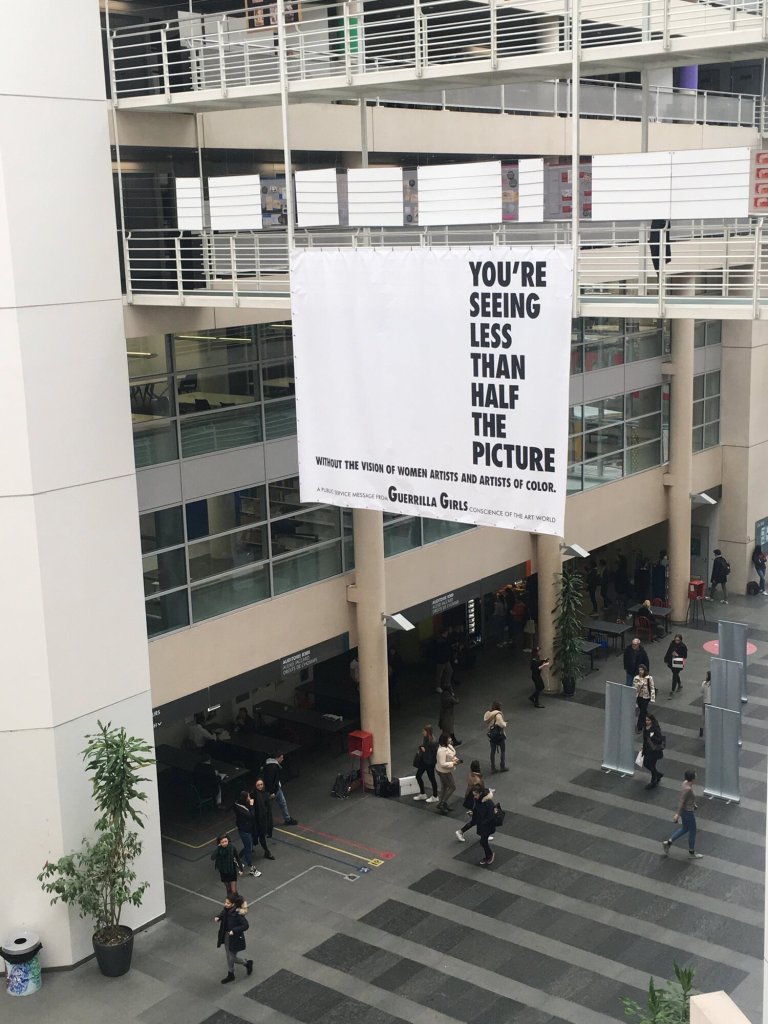
Protest art is a very fluid and mouldable thing, as a lot of boards are often inspired by boards created from another movement and era. Well known names like Guerrilla Girls and Extinction Rebellion have found their mojo in the creation of protest art, finding that it’s something they were quite good at. What you find from looking at their creations is that although they appear to look very different, they have a lot of the same qualities. Clear messages, strong type, effective imagery, protesting in the right location at the right time. If what you’re protesting is presented in the right way to the right people, the message will be sent.

As always, links to works are on the related images. Anything said in this was not meant to offend anyone, I’m still learning so please correct me if I’ve made any mistakes or been insensitive in any way. If you’re making protest art anytime soon, don’t forget strong messages, clear type, and effective imagery. You want your message to be heard.

If you wish to use your voice in these uneasy times, here’s some helpful links;

A list of petitions, including donation pages like George Floyd Memorial Fund, Campaign Zero, Minnesota Freedom Fund, Justice for Breonna Taylor, along with a bunch more GoFundMe’s for victims that can be found here.

If you can’t donate, there are ways to educate yourself;

Netflix’s BLM Section including 13th as now available on YouTube, and When They See Us as a personal recommendation. A list of reading, other films and podcasts on this topic are linked here.

Cheers,

Abi x

in the shadows

With more than enough time on my hands with the current state of the world, I thought it about time to crack out my laptop, endlessly research and write another post. After a fair bit of aimlessly swimming around the depths of the Internet, I happened upon Coraline, The Nightmare before Christmas and the curious relationship between Tim Burton, Henry Selick and Disney. I’ll start from the beginning.

Coraline is by far one of the most impressive pieces of film ever. Understanding the process that the team go through to get to the finished outcome is a little mind boggling at times, but once you get your head around how much work, time, money (and I’m sure blood, sweat and tears too) it takes to produce of film of this standard, you really get to appreciate the craftsmanship. It’s astounding. If you’ve never seen Coraline (which you absolutely should have), it’s a story of an adventurous, young girl who finds a secret door in her new home that leads to a topsy turvy version of her life, where everything isn’t all as it seems. Exploring themes of courage, fear, childhood and dissatisfaction, Coraline was released in 2009 after over 4 years in production as the first 3D stop motion film and received a marvellous reception. Henry Selick, the director of the film, who worked with Laika at the time of production, is very open about the making of the film, going into detail of the intricate lengths they went to to achieve the finished outcome. With more than 28 animators working at one time, the production per week was approximately 90-100 seconds of film, without editing.

If you’ve ever played with stop motion before, you’ll know it’s a lengthy process as it is because the film is created by the placing of photos in a sequence at a fast frame rate per second to create a smoother looking movement, meaning hundred of pictures are usually taken to create just seconds of film. However it’s even lengthier to create a film like Coraline as the building of the scenes and characters, who all had interchangeable body parts and facial expressions, was done through 3D printing that had to account for easy access to move the parts slightly between shots. By this I mean, sets often had trap doors or access from beneath that animators could get into to move the character or scene between photographs. Each character had multiples because of wear and tear in production, even down to the clothes that were micro knitted up to 30 times per outfit that had to be identical down to the way that pattern matched on the seams. Taking 10 people 3-4 months to create one character, Coraline had 6300 face replacements alone, all being hand sanded and painted. Two shots were taken at slightly different angles to make the film an option for 3D, and the parts of the image that had to be animated, including the smallest items such as a couple of leaves or a piece of hair, all had to be wired and set ready for post production work. Although there were up to 450 people working on this film, Henry Selick, director of production, is the man to praise for Coraline, which is nothing short of a masterpiece.


After looking into Selick a little more, I found he also worked on films like James and the Giant Peach, The Fox and the Hound, and Tim Burton’s The Nightmare Before Christmas. I thought this rather strange because I’d never come across Selick before and after all it’s Tim Burton’s A Nightmare before Christmas, not Henry Selick’s. Obviously from the title you presume that Tim Burton is the sole man to blame for one of Disney’s most successful stop motion films. However this is far from the case. Tim Burton is a household name in terms of slightly creepy children’s animations, and worked for Disney during the changes to the system between old and new management of the early 1980s. Whilst also working on Fox and the Hound, Burton wrote a poem and some sketches based around the yet to be created The Nightmare Before Christmas, sharing these with fellow colleagues such as Selick and executives that had no interest in production at this time. After massive success from Batman and Beetlejuice, Burton was hoping to ride the wave of glory and found that Disney still owned the rights to The Nightmare Before Christmas as it was created during Burton’s employment with them. This was to be his next passion project. Knowing that it was to be an animation, Selick was brought in as director, the same role he played in the making of Coraline, to bring Burton’s story to life. Selick was given creative freedom and a budget to do so, while Burton spent days deciding the pattern of Sally’s socks. The film was created in a way so similar to Coraline, with the trap door sets, puppets and stop motion style, yet when it came to release, the film was named Tim Burton’s The Nightmare Before Christmas. A bit of a kick in the teeth, right?

Although this was a simple marketing adjustment made by Disney to ride with Burton on his wave of success, poor Selick was hardly mentioned when it came to praise for the film. Selick was given the praise from Disney by being presented with the gift of directing James and the Giant Peach, soon after going on to make Coraline with Laika. Disney and Burton seemed to be secretive about the means of production of The Nightmare Before Christmas, but with Selick and Laika being so open about the means of production therefore making Coraline even more impressive, I think this is an opportunity they massively missed out on. After returning to Disney in 2010, the two films Selick started production on got cancelled and he left Disney in 2012 due to scheduling and development, after creating nothing. Since then, it’s reported that Selick is in production for a couple of films, including one picked up by Netflix in partnership with Jordan Peele.

What started as what was supposed to be praise for Coraline, ended up as a reveal for unfairly credited work. Far too often, work isn’t credited properly and the true genius behind work is left ignored. Tim Burton isn’t at fault, and who can blame Disney for wanting their film to do well, but poor Henry Selick. Coraline is now often mistaken for a Tim Burton film after The Nightmare Before Christmas, when both truly belong to Selick. Let’s hope Henry Selick will not always have to live in the shadows of Tim Burton because of one greedy marketing decision.

As always, there are links on the images to relevant works including some super interesting videos on the making of Coraline. Deffo worth a watch.

Cheers,

Abi x

things you didn’t know you needed to hear

January is shit. I don’t care what people say about all this new year bollocks, it’s just another month full of long dark days where everyone’s a bit tubby from eating too much chocolate over the holidays and no one has money because of Christmas. January blues are a real thing. Everyone hasn’t seen the sun in a while (unless you’re a lucky bastard that can afford a chrimbo trip abroad), you’ve got that cold that you’ve had for what feels like forever that won’t seem to shift and you now have nothing to look forward to. It’s completely normal to have a bunch of negative feelings around this time of year. Low mood, sadness, low energy, no motivation and high anxiety levels are just a couple of common symptoms of this post Christmas come down. We’ve all been there.

Recently on Instagram, my explore page has been full of self care messages and cute illustrations. Now obviously, if you’re really struggling with mental health, I’m not saying that looking at a few quotes is going to cure you or solve anything, but sometimes it gives you a little more hope than you had before. It can be a nice reminder to look after yourself, and give yourself a break that you really need. All of the images linked are made by artists that create this kind of content, so it’s super easy to fill your feed with these positive reinforcements. I don’t want to waffle on too much, but here’s a couple of my favourites that I’ve seen over the last few weeks.

Links to artist, as always, are on their images. Here’s a couple of numbers that could be helpful if you need a chat or are in crisis: 116 123 – Samaritans 24 hour helpline, 111 – NHS urgent medical issues or visit here for more information on what to do and who to call for listening services. Please don’t be afraid to contact your GP if these ‘January blues’ aren’t going away.

Please take care of yourselves.

Cheers,

Abi x

giving the credits credit

Can you remember the title or credit sequence of the last film you watched? I’m guessing the answer is probably a no. You can have a simple rolling credit that clearly isn’t important enough to stay in the cinema for, or you could go the right way about it and make a credit or title sequence that is actually worth watching. A lot of people jump the gun and leap from their seat as soon as the screen goes black in the cinema to avoid the queues in the toilet, but sometimes (rarely) there’s something worth sticking around for. Now I’m definitely not perfect, this is a mistake I wrongly made at the end of Stranger Things 3 (if you know, you know), but after running out of blog post ideas and researching these sequences I’m going to do my best to pay more attention.

To make a sequence that I personally am going to be somewhat interested in, it’s probably got to include, you guessed it, illustration. The perfect sequence tells enough about the story that it relates but doesn’t give too much away that it reveals the full plot, almost like the blurb of a book. Usually, the scenes in the more interesting sequences kind of run into each other as if you’re following a story transitioning from scene to scene rather than rolling like a usual credit. Some are placed at the end, and others at the beginning. This usually depends on how detailed the sequence is, for example if it reveals a major story plot then it’s obviously going to be placed at the end of the film or episode. Despite this, many sequences like to give little Easter egg clues that you have to slow down the video to be able to notice. Others are that detailed, it can be hard to appreciate just how thoughtful the creators have been about the contents of each scene. This is the case for my first of 6 favourite sequences.

Grease (1978)

The well loved Grease title sequence is a classic in terms of 2D animation. The unfinished style and jumpy animation is created by John Wilson using 6-12 drawings per second and is full to the brim of Easter eggs, all being social and historical nods to the time between the films setting of 1959 and the creation of 1977. If you were to slow it down, you’d not only find images of Stalin but also notice gentle relevance to the film such as the Pink Ladies poster in Rizzo’s bedroom. There’s reason this is one of the most well known title sequences to date.

Good Omens (2019)

Jumping forward slightly, a recent discovery of mine is the Good Omens title sequence created by Peter Anderson using an amalgamation of 2D, 3D animation, live action shots and illustrations to portray the ‘British bonkers’ theme Anderson and his team were after.

This sequence is one that is different every time you watch it, discovering things you didn’t see the last time. The first that I noticed was the wilting cactus, an Easter egg I won’t spoil for those of you that haven’t watched the series, and the second I read in the article linked on the video, where it explained in an interview with Anderson that every character has Aziraphale and Crowley’s faces. The interview is super interesting and definitely worth a read.

Ratatouille (2007)

Bonkers is probably the word you’d use to describe the story of a rat becoming a chef however this is something Teddy Newton manages to portray to the audience so naturally and without question. Of course a rat can become a chef! The credit sequence has a style that shown in the film when Remy (the rat) is describing how flavours are shown in his head. With tough acts to follow, such as the Incredibles title sequence along with others that set the bar for 2D animation within Disney and Pixar, this is one of my favourite sequences that seem to all follow one shot. Created in Photoshop through scanned images, this kind of sequence gives illustrators like me a little hope that not all image creation has to be completely digital.

Catch me if you can (2002)

Arguably on of the most well known designers within the title sequence and movie poster world, Saul Bass inspired this masterpiece created by Kuntzel and Deygas for ‘Catch me if you can’ featuring Leonardo Dicaprio. Using a lino print style, the sequence’s scenes and figures are entirely printed using a small set of stamps with detachable limbs. Heavily influenced by the 1960’s, the figures even have hairstyles and outfits to match the era, how cute!

Game of Thrones (2011)

This sequence is one that could have a full post of its own. The Game of Thrones title sequence is one that visits location to location throughout the Map of Westeros created by Angus Wall with Elastic. This sequence creation is far more complicated than I’m willing to go into for this one small paragraph, so I’d go and check out the interview with Wall to find out more. Very fitting with such a complicated show I suppose. One of the most impressive things I’ve seen from this sequence is that although they take up to 6 months to be made by the team, the alterations between each sequence in season 8 perfectly align with the story per episode even with the addition of Easter eggs.

Monsters, Inc (2001)

Last but certainly not least is my favourite and in my opinion the most memorable, Monsters. Inc. This is the Disney animation that set precedent for the more recent 2D animation sequences. Created by Geewee Boedoe, who has one of the most unique styles in his own illustrations, Monsters. Inc is another like Ratatouille that uses scanners, Photoshop and Aftereffects to create this kind of magic. With the delightful upbeat music and the sweet hand drawn effects of the animation, the sequence shows door to door scenes paired alongside the children screams in audio, giving away just enough about the film that those who have seen it, will get the references.

All of the images have links to the amazing website where I found all the information about these sequences – Art of the Title- and others are links to the creators, all of which are definitely worth checking out as they include interviews about creation that are so interesting but I obviously couldn’t include all the info otherwise this would’ve been pages and pages long. I think what I’ve really learnt from all this research is that the sequences are as much a part of the film as any scene and they definitely deserve more credit. We should all cross our legs for a little longer, the loos can wait.

Cheers,

Abi x

copycat

Finding your own style is damn hard. Your Instagram follows consist of cohesive ‘got their shit together’ designers whose posts all look like they belong in a frame on a cute website where you could spend your entire life savings. It’s tiring endlessly scrolling, seeing people doing the shit that you want to do but don’t even know where to begin, I get it. As I’m sure a lot of inspiring illustrators can agree, copying is usually how you eventually start. Or that’s how it happened for me anyway.

Before I knew that graphic design was the one for me, I did a lot of drawing. In school as part of my GCSE, for each artist you researched, you had to do a copy of one of their pieces. This was all well and good until you get to A Level and copying is no more. You’re simply ‘inspired’ by an artist, maybe by the colour palette you’ve used or the theme behind the image. Moving from becoming completely reliant on copying to doing things solo is like a toddler taking their first steps and then asking them to do a 100m sprint. You become comfortable to say the least.

At sixth form, I took up graphics and found a lot of designers I loved but nothing on their instagrams, websites, behances, about process. Because I’d never done this sort of drawing before, I knew copying was the way to go about it, but it’s anything but easy to make a copy of something if you don’t know how they did it. But then I found Fran.

I found Fran on Instagram (of course) and immediately fell in love. Her illustrations are simple, yet delightful. At the time, she was using black and white line over coloured shapes done using promarkers. I knew this because she was the first illustrator I found to have a Youtube channel and to utilise the story feature on insta to show small drawing videos. I was fascinated, watching her use coloured pencil to sketch out the illustration and then go so confidently over the top with marker and finish with a very precise use of monochromatic line. It seemed so effortless, as easy as tying your shoelaces or getting dressed it the morning. It was like second nature to her and that was I’d been searching for.

I already had an array of promarkers and some well loved fineliners, so I took pen to paper and made some very terrible attempts to copy. Here’s where it gets easy to give up. You see a couple of your shoddy attempts and then convince yourself you’ll never amount to anything in the world and that everyone would just be better off if you never picked up a pencil again. But I needed to be comfortable enough to draw only being inspired by her, so carrying on was the only option. In my gap year (yes it took me this long to get comfy) I did a lot of crappy drawings that I hated, because I knew once I’d got my place at university, summer work would soon be assigned and I had to be good. The task was eventually revealed- we had to creatively portray a day out of our summer however we wanted. This was a pretty good excuse to finally give a crack at my own drawing.

Definitely not my best work, but I was unbelievably relieved to see that the first attempt had kinda worked out. I carried on like this and did a few different arrangements of my day, all of which you can see on my Instagram. At this point I was still giving credit in my captions to Fran because I was still very much attached to her style in terms of colour palette and technique (and artists take credit very VERY seriously). However now I’m doing my own thing. Fran taught me how to draw like this through all of her videos and other good stuff on her platforms, her website is particularly good for showing how she makes her illustrations and the medias she uses. This being said, like a caterpillar to a buttery, I’m now spreading my wings. I still draw in a very similar style, don’ get me wrong, but I think it’s finally becoming my own.

Fran now takes on more of a blue theme in her illustrations, using blue rather than black fineliners, and her physical form has changed a lot since I first found her. She made a super interesting video recently that discussed the changing of her own personal style and how she overcame it. Her Instagram goes back quite a few years, so you can see the style progression. I’m saying I’m finding my style but I guess what I’ve learnt from Fran is that the more you draw the more your style grows and changes, so I know that my illustrations wont be this way forever. On top of all this platform running, she’s also running a super cool business here with her husband Ed where they recycle, print and resell second hand t-shirts.

Fran is one of those Instagram accounts that I envy, but it soon becomes very clear that behind closed doors, she works bloody hard to be as on top of her game as she is. As does every designer with their shit together. A couple of Fran’s links are available if you click the images on this post, as with every designer I mention, if you wanted to check out and delve a bit deeper into the making of illustration. I suppose this post is just a massive fangirl and a bit of a thank you. Everyone has design heroes and here’s one of mine.

Cheers,

Abi x

a band with a brand

Branding is absolutely essential for creating identity. For example, if your favourite vegan food brand started using tons of none recyclable packaging, it wouldn’t exactly align with brand image. Creating a no loop hole look for whatever you’re branding just creates such a professional and polished aura that it becomes the cherry on top for a successful brand.

Now branding for a band can be somewhat difficult. It’s easier to brand something that doesn’t have a face. It’s all well and good making the logo, merch or a transferable colour palette, but if the lead singer goes out and bashes drugs every other weekend and is displayed in all the headlines as a complete smackhead, I’m not sure about you, but that would probably skew my views of their image a little. It depends what you’re into I guess.

Haim are a band I’ve been listening to since 2016 when I found them after hearing rumours Alana Haim was dating Van McCann (the love of my life, fan girl fantasy and future husband at the time). Described as a pop rock band from LA, they consist of three very talented sisters, Danielle, Este and Alana, making music compared to the likes of Fleetwood Mac. Rejecting your typical girl band label, they are the embodiment of 70’s cool girl chic intertwined with sisters next door.

Before I get onto how these girls really complete their brand, it’s only a given I talk about their graphics first. It’s pretty hard to find any kind of names, companies or information about the designs behind the band, but the typeface looks very similar, if not is, a font called Nouvelle Vague Final. It’s a serif font created by Dirk Schuster that he describes as a new creation of an extreme Didone typeface. When looking into Didone typefaces, it seems they were mainly used for high gloss editorial work to enhance crisp European design between the 18th and 19th Century. However this sister font combines the clean, regal feel of the original, matched with the 70’s personality of the band. This specific type is only used for the logo, but it marries well with the serif type variations used on the album covers too. They do seem to the transitioning into a more sans serif type that I could find absolutely nothing on the internet about, but for the majority of their previous albums it’s looking like they’ve used this logo and this is what they’re identifiable by.

As for the girls themselves, let’s just say I wanna be pals not only because they seem great but so that they can PLEASE let me raid their wardrobe. When researching about Haim style, many say it’s the perfect laid back 70’s look, which I can completely agree with but there’s something a little different here. Sometimes when people adopt the dress of a different era, it becomes their personality. Very ‘I could NEVER wear anything made after 1974’ kinda girl, if you understand me. But with these girls, it seems they just wear what they like and like what they wear giving that real authentic feel. It just works, especially considering all the 70’s fashion is back in right now with oversized jackets and flares being all the rage. Not only this, but the casual no makeup vibe they choose most of the time really just finishes the whole look off. After keeping up with their instagram stories, you can see that they’re just normal, unproblematic sisters that are living the dream.

I think what we’ve learnt from this is that you should go and give them a listen right now (rebecca that one’s for u) just to see how the music matches all of the above. It’s crazy how well branded these ladies are, it almost feels like a happy accident. With the release of their new single ‘Summer Girl’ it’s the perfect time to just jump on that Haim bandwagon and end up as obsessed as I am.

Cheers,

Abi x

design even the demogorgon wouldn’t mess with

If you haven’t binged Stranger Things by now, I’m judging you. I would call you a mouthbreather but you wouldn’t even get the reference. Now don’t get me wrong, Netflix has a LOT of films, series, documentaries to browse through (most complete crap of course – shit like ‘Weightlifting Fairy Kim Box Joo? or ‘Beauty and the Bestie’ to name a couple) but as one of Netflix’s biggest successes, it’s a show that can’t be overlooked. With the third season fast approaching, I thought it appropriate to gush about the graphics in my first proper blog post.

For those of you that haven’t watched, Stranger Things is an American Horror Thriller series set in the 80’s following a group of young boys and their families through what Netflix describes as scary and ominous events. Obviously there’s more to it than it sounds but I know how it felt to be on the receiving end of spoilers with Game of Thrones so I’ll say no more. From the garish wallpaper to the big square boxes that are TV’s, the set on the show really encapsulates the 80’s vibe without going too overboard. Subtle nods to the era, such as relevant film posters on the walls, or the style of bikes that the boys ride, really help to paint the scenes in ways that aren’t overbearing or distracting. This married with the colour overlay and graininess of the film capture the ominous and scary themes that Netflix list in the description. So the graphics should mirror this too, right?

Now onto the exciting part. The graphics within the show are just another one of the many hints to indicate the era. It wasn’t easy to find the people behind this, but the main name I found was Heath Hancock. After accessing his portfolio, I found a page full of graphics he’d provided for the show, all of which truly had me in awe. Obviously a lot of work goes into these kind of things, especially when they have a big budget, but you don’t quite realise until you see it.

The use of graphics in this way is to really create a whole new identity from scratch. Identity for the town is so important, especially for Hawkins where we are so in line with the police force and community services within the story because we see the same logos and typography over and over again. It’s so central in being able to recognise who certain characters are or quickly understanding whether they’re the good or bad guys. Not only this, but then for Hancock to align this with the era by using the same type, colour palette and setting is very impressive. He has loads more stuff than this on his page, deffo worth checking out. This dedication is also mirrored in the very recognisable title type created by Michelle Dougherty. Using the primary type face Benguiat, the title reflects the tone of the era and themes perfectly especially due to the Stephen King connotations.

Here’s the graphics that I find most impressive. The one’s that make me kinda drool ngl. Each year that the series releases a new season, along with it comes new promotional posters. After jumping on the bandwagon with the first season, when they announced the second season for the Halloween in 2017, excited didn’t quite cut it. But then I saw the poster.

How gorgeous is that? Like wow. Come on. The man behind this magic, and the magic that has baffled me each press release is Kyle Lambert. As the creator of over 150 film posters, his portfolio is anything short of disappointing. After reading a couple of articles on him, I found he uses an iPad Pro with an Apple Pencil in Procreate which seems to be the way a lot of illustrative graphics are leaning these days. And, I’m not going to lie, if this doesn’t convince me to start saving, I don’t know what will.

If you’ve seen any of the scenes in Stranger Things, you’ll know that the colours, themes, tones, everything is perfect in these posters. Honestly not a hair out of line. I could only dream of ever making something this pleasing to the eye. They really fucking smashed it.

God yes, I’ll be watching the release on the 4th of July, and you should be too. I hope that wasn’t too painful to read.

Cheers,

Abi x

an introduction to what could be a disappointment

I feel like it’s only a given that I start this with an apology. I’m not much of a writer and as this is a university summer project, it could be somewhat of a left down. Sorry.

I guess I better tell you who I am? My name’s Abi and I’m to be a second year Graphic Design student at Nottingham Trent Uni, the whole reason why I’ve created this pain in the arse of a blog. I’m from Hull but obviously currently based in Notts for uni. I also really like dogs? but I’m not sure if that’s relevant because this is a design blog not my Tinder bio.

Being a design blog and all, now’s probably the time I tell you that I’m mainly interested in illustration, so I’d expect to see a LOT of that on here. I’m interested in a ton of other stuff too, but I’m a bit crap at the rest so it’s easier to be into something I’m alright at.

I really don’t want this to be some kind of formal thing where I write about how the designer used the colour blue to evoke sadness, so it’s probs gonna be pretty cas. So I’ll write again maybe mid September when I’ve realised I’ve not kept up with this thing and will have to write an entire summer’s worth of blog posts overnight. Sorry again.

Anyway, that’s that. Cheers.

Abi x